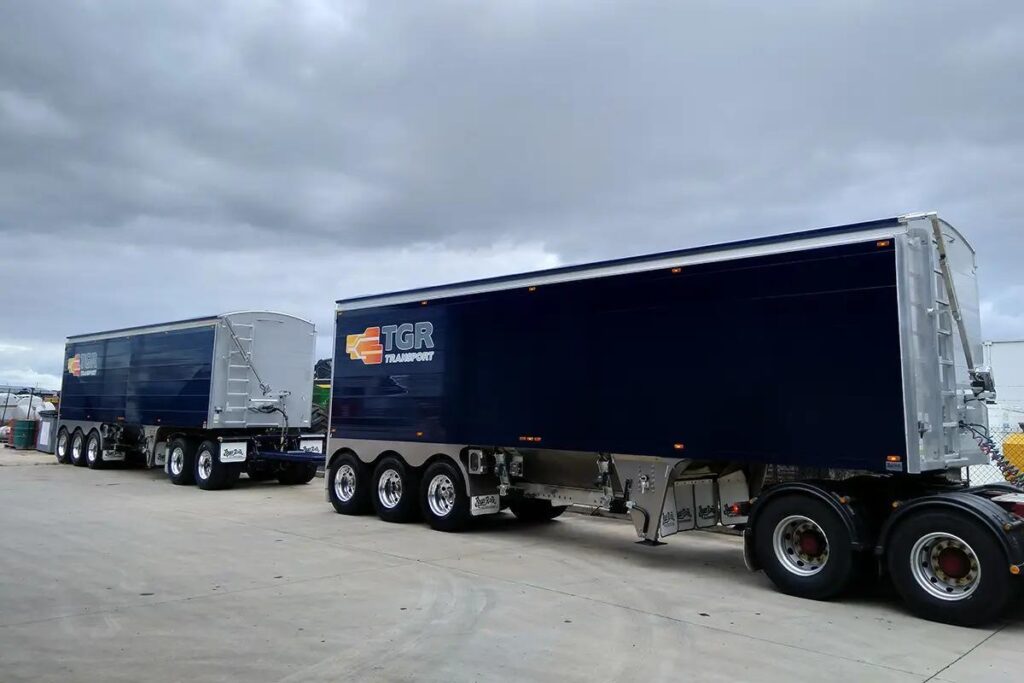
Belly dump trailers are a specialist piece of equipment built for one thing: high-volume spread work at pace. They are not a like-for-like replacement for an end-tip fleet, and specifying the wrong trailer for the wrong application is a costly mistake.
This guide covers the practical detail contractors need before making that decision, including how belly dumps work, where they perform best, key specifications, and how to match trailer configuration to the demands of the job. Each section is written for operators who already understand plant, not for those starting from scratch.
How a Belly Dump Trailer Works
A belly dump trailer discharges material through a longitudinal gate fitted along the underside of the body. The gate opens hydraulically, releasing the load in a continuous windrow as the prime mover travels forward. This differs fundamentally from end-tip operation, where material drops at a single point and requires additional spreading by a dozer or grader. The bottom-discharge mechanism allows for consistent, controlled material placement across the full length of a run.
This is particularly useful on road base construction, embankment builds, and large pad preparation where uniform spread thickness directly affects compaction outcomes. End-tips require multiple passes and significantly more dozer time to achieve the same result. On linear works especially, belly dumps reduce the number of plant interactions required between dump and compaction, improving both cycle efficiency and site safety.
Primary Applications of Belly Dump Trailers in Civil Construction
Belly dump trailers perform best on open, linear, or large-area earthworks where uninterrupted material flow is an operational advantage. Road base spreading and sub-base preparation are the most common applications, as the continuous windrow aligns directly with grader and compactor workflows, reducing idle time across the spread train. Mine haul road construction, dam wall embankments, and airstrip sub-grade preparation follow the same logic.
These trailers are not suited to confined tipping areas, tight access sites, or jobs requiring precise spot placement. The discharge gate demands forward movement during unloading, which means sites with limited run-out distance will constrain productivity or create operational risk. Contractors should assess site geometry before committing belly dump equipment to a job, as a mismatched application eliminates the productivity advantage entirely.
Key Belly Dump Trailer Specifications to Understand Before Buying
Payload capacity must be matched to the prime mover’s rated combination mass and the haul distance involved. A higher-volume body on a short haul cycle will maximise payload per trip, but the same configuration on an extended haul may exceed safe operating limits or reduce fuel efficiency. Body volume and rated payload are not interchangeable figures and both need to be assessed against the specific job parameters.
Gate configuration has a direct bearing on spread width and material control. Twin-gate systems allow the operator to open each side independently, offering better command over windrow placement on variable terrain. Single-gate setups are simpler mechanically but offer less flexibility. Chassis and suspension specification also warrant attention, particularly on unsealed haul roads where under-spec suspension accelerates frame fatigue and increases maintenance cost over the trailer’s working life.
Operational Considerations and Site Requirements for Belly Dump Trailers
Belly dump trailers require relatively flat, stable haul roads with adequate clearance beneath the trailer body during discharge. Ground undulation or soft spots mid-run can cause uneven gate loading, inconsistent windrow depth, or, in severe cases, gate damage. Site preparation of the haul corridor is a prerequisite, not an afterthought.
Operator technique has a measurable effect on spread quality. Travel speed during discharge controls windrow width and depth, where travelling too fast produces a thin, inconsistent layer and too slow can cause material to bridge or build up at the gate. Turnaround logistics also differ between pad work and linear road construction. On large pads, spotting multiple trailers in sequence maintains spread train momentum, while linear works require careful coordination of haul direction to avoid head-on conflicts on single-lane haul roads.
Productivity and Cost Considerations for Belly Dump Operations
On spread-intensive jobs, belly dump trailers consistently reduce cycle time compared to end-tip configurations. Eliminating a dedicated spread pass, or reducing dozer push requirements, compresses the gap between dump and compaction-ready surface. On large road base contracts, this translates directly into fewer plant hours and lower cost per tonne of material placed.
Labour and equipment utilisation both improve when the spread train runs efficiently. Less dozer time on push work means that plant can be redeployed or reduced on site. When pricing belly dump work into a tender, contractors should calculate cost per tonne across the full spread process, not just haulage, to capture the true productivity differential against an end-tip alternative. This is where the investment case becomes clear.
Selecting the Right Belly Dump Trailer for the Job
Configuration choice between a single trailer or road train depends on haul distance and total volume. Road train combinations carry significantly more payload per trip and suit long haul corridors where the additional combination length can be safely managed. On shorter hauls or sites with constrained turning circles, a single trailer configuration is more practical and often more cost-effective when factoring in prime mover requirements.
When assessing second-hand equipment, gate wear, hydraulic cylinder condition, and frame fatigue are the primary inspection points. A worn or misaligned gate will produce inconsistent spread and may require costly rectification. Contractors looking for a reference point on current belly dump trailer specifications and configurations can review the belly dump trailers range from Bruce Rock Engineering, which covers options suited to civil and resources sector applications.
Choosing the Right Belly Dump Trailer for Civil Earthworks
Specifying a belly dump trailer correctly comes down to three considerations in sequence: application suitability, specification matching, and operational readiness. A trailer that fits the job, suits the site, and is operated within its design parameters will return a measurable productivity advantage over alternative configurations.
We offer a range of belly dump trailers suited to civil and resources sector applications. Contact the Bruce Rock Engineering team to discuss specifications or request an enquiry.