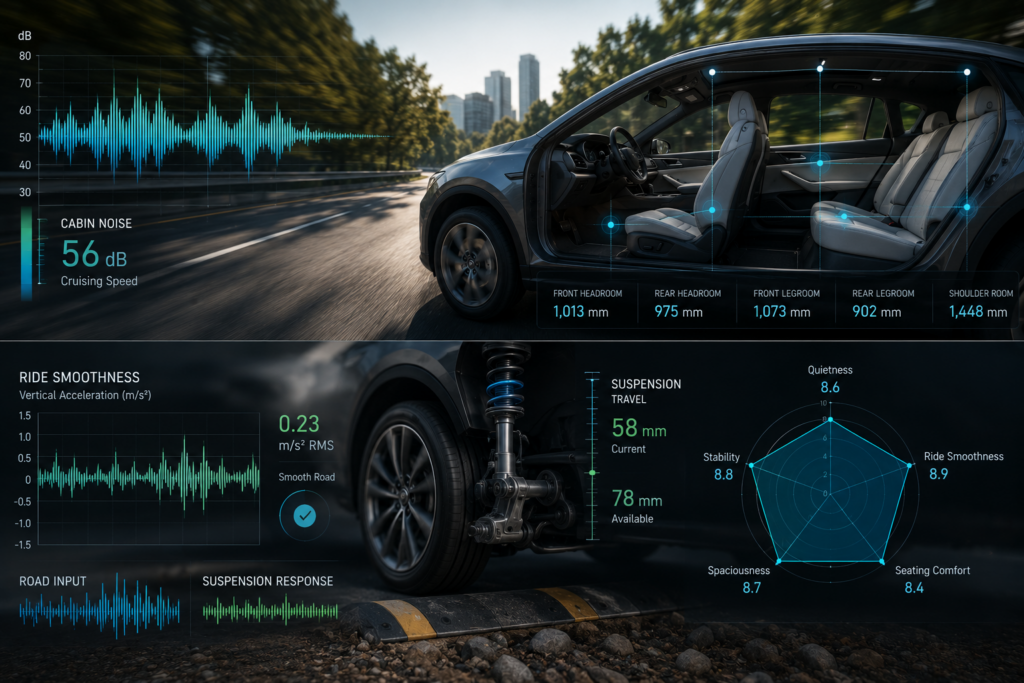
Comfort has become one of the defining qualities of the modern car. Buyers talk about refinement, smoothness, cabin quality, and quietness with the same seriousness once reserved for horsepower or top speed. Yet comfort itself is surprisingly difficult to describe. It is deeply physical, highly psychological, and shaped by dozens of subtle engineering decisions working simultaneously in the background.
What makes one car feel relaxing on a long motorway journey while another becomes tiring after half an hour? Why do some cabins immediately feel calm and spacious even when dimensions are similar on paper? And how do manufacturers actually measure something as subjective as ride comfort?
The answer lies in data. Modern automotive comfort is increasingly quantified through measurable variables including decibel levels, suspension travel, vibration frequencies, seat geometry, and interior spacing. Behind every “comfortable” car sits a large amount of engineering mathematics designed to shape how occupants physically experience movement.
Cabin Noise Is Measured More Precisely Than Most Drivers Realise
One of the clearest indicators of comfort is noise.
Humans are remarkably sensitive to sound changes inside enclosed spaces, particularly during long journeys. Even relatively small increases in cabin noise can contribute to fatigue over time, which is why manufacturers spend enormous resources refining acoustic performance.
Noise inside a car is typically measured in decibels (dB).
L=10log10(II0)L = 10 log_{10}left(frac{I}{I_0}right)L=10log10(I0I)
This logarithmic relationship matters because sound intensity increases rapidly. A cabin measured at 70 dB is not merely slightly louder than one at 60 dB — it represents a substantial increase in perceived noise energy.
For context:
- Quiet luxury EV cabins may operate around 60–65 dB at motorway speeds
- Many mainstream family cars sit closer to 68–72 dB
- Older vehicles or poorly insulated cabins may exceed 75 dB during motorway driving
Those differences affect how tiring a journey feels, even if occupants do not consciously notice the sound itself.
Modern vehicles reduce cabin noise through multiple techniques simultaneously. Acoustic glass, improved door seals, aerodynamic optimisation, tyre design, and active noise cancellation systems all contribute to lowering overall sound levels.
Electric vehicles have accelerated this focus further. Without combustion engines masking background frequencies, tyre noise, wind turbulence, and suspension vibrations become far more noticeable.
Ride Comfort Is Largely About Controlling Motion
Smoothness is another area where subjective feeling relies heavily on measurable data.
When drivers describe a car as “comfortable”, they are often reacting to how suspension systems manage vertical movement across uneven surfaces. The challenge for engineers is not eliminating motion entirely — which would feel unnatural — but controlling how quickly and sharply movement reaches occupants.
Suspension travel, damping rates, and vibration frequency all play important roles.
Human bodies are particularly sensitive to certain vibration ranges. Repetitive oscillations around 4–8 Hz, for example, can increase fatigue and discomfort during longer journeys. Automotive suspension systems are therefore carefully tuned to minimise exposure to these frequencies where possible.
Wheelbase also affects perceived comfort significantly. Longer vehicles generally distribute bumps more gradually because the front and rear axles encounter road imperfections at different moments. This helps explain why larger saloons often feel calmer on uneven roads than shorter hatchbacks.
Tyre size influences comfort as well. Larger alloy wheels may improve visual presence and steering sharpness, but lower-profile tyres often transmit more road imperfections into the cabin. This is one reason why some high-specification trims feel firmer than entry-level versions despite appearing more premium.
Space Perception Is Psychological as Much as Physical
Interestingly, interior comfort is not determined solely by raw dimensions.
Manufacturers measure headroom, legroom, shoulder width, and seat positioning precisely, but human perception of space depends on additional psychological factors. Window size, dashboard layout, seating height, ambient lighting, and colour palettes all influence whether a cabin feels open or confined.
This is why two vehicles with nearly identical measurements can create very different emotional impressions.
Modern interior design increasingly focuses on visual calmness as much as physical ergonomics. Minimalist dashboards, integrated screens, hidden air vents, and uncluttered surfaces are often intended to reduce sensory overload rather than simply modernise aesthetics.
This shift reflects a broader understanding within the industry that comfort is deeply connected to mental relaxation. A cabin that feels visually chaotic can become cognitively tiring, particularly in heavy traffic or during long commutes.
As cars evolve into more personalised environments, drivers are also placing greater emphasis on identity and atmosphere. Exterior styling choices remain part of that equation. For motorists interested in creating a distinctive overall vehicle presence, companies such as Number 1 Plates exist within a wider culture of automotive presentation and personalisation that extends beyond pure functionality.
Why EVs Are Redefining Comfort Standards
Electric vehicles are changing expectations around comfort faster than almost any previous automotive trend.
The absence of engine vibration creates a smoother baseline driving experience immediately noticeable to most drivers. Instant torque delivery also eliminates many of the gear changes and mechanical interruptions associated with combustion engines.
As a result, consumers are becoming more sensitive to secondary comfort factors they may previously have ignored. Wind noise, seat support, suspension calibration, and cabin materials now receive greater scrutiny because fewer mechanical distractions mask them.
This has created new engineering challenges.
A heavier battery pack can improve ride stability by lowering the centre of gravity, but it also increases overall vehicle mass, meaning suspension systems must work harder to absorb impacts effectively. Engineers are therefore balancing refinement and weight management more carefully than ever before.
The rise of EVs has also increased interest in acoustic design. Some manufacturers now intentionally create artificial cabin sounds because total silence can feel unfamiliar or even unsettling to occupants accustomed to traditional engine feedback.
The Most Comfortable Cars Often Feel Effortless
Perhaps the most interesting thing about automotive comfort is that the best examples rarely draw attention to themselves.
Drivers tend to notice discomfort immediately — excessive tyre roar, harsh suspension, cramped seating, intrusive vibrations — but true refinement often feels invisible. A well-engineered car simply allows occupants to arrive less fatigued, less tense, and more relaxed than they otherwise would have been.
That experience is the result of countless measurable adjustments happening beneath the surface. Noise frequencies are filtered. Vibrations are dampened. Airflow is controlled. Seating angles are calculated carefully. Cabin proportions are optimised around perception as much as practicality.
Comfort, in other words, is not accidental softness. It is engineered precision designed to feel natural.
As modern vehicles continue evolving into connected living spaces rather than simple transport machines, the science of comfort is becoming just as important as performance, efficiency, or technology itself.