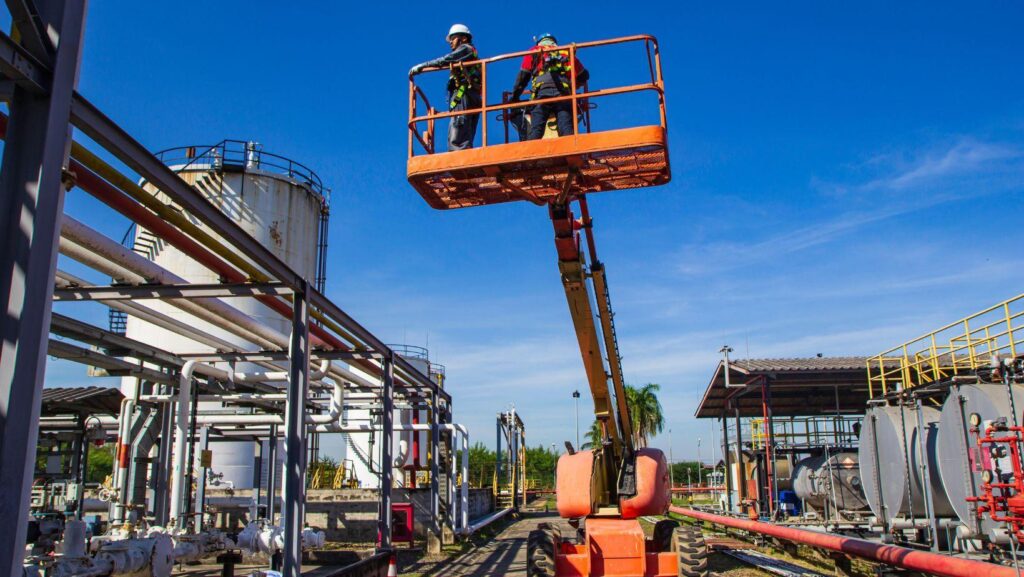
When you look at a truck-mounted aerial lift, you admire its design for offering the mobility of a commercial truck and the lifting capability of an aerial work platform. These boom trucks can safely carry both workers and materials to elevated heights. They use their hydraulically powered arms for this purpose. The lifting mechanism is mounted on the sturdy truck chassis. As a result, workers can perform construction tasks, utility repairs, and other jobs at height hassle-free. To be precise, this equipment is suitable for applications requiring greater reach and lifting capacity. Since buying equipment like this is often expensive, you can explore aerial lift rental options.
Rental services give you the flexibility to choose suitable models for your projects for as long as you need them. If your requirements change, you can upgrade or select a model that exactly meets your needs. No matter which truck-mounted aerial lift or mobile elevated work platform you rent, you should know that its efficiency depends on the strength and performance of its three important structural components, such as the boom, slewing mechanism, and outriggers. Let’s understand their roles and functions.
- The boom
This specific component is available in two distinct configurations: telescopic and articulating. The boom is the most visible part of any truck-mounted aerial lift. You can use a telescopic boom for jobs that require maximum vertical or horizontal reach in a straight line. The boom extends like a telescope. You can use it to reach your work area without obstruction. An articulating boom is also called a knuckle boom because it contains multiple hinges, or knuckles. It cannot match the straight-out reach of a telescopic boom. However, articulating boom lift allows you to work around building overhangs, power lines, and similar obstacles more safely. It is also an ideal pick for confined or hard-to-reach work areas.
- Slewing mechanism
You can also refer to it as the turntable or turret. This rotating base is the main connection point between the truck’s chassis and the boom. It allows the boom to rotate up to 360 degrees, depending on the model or configuration. A hydraulic motor and gear system work together to provide smooth and precise rotational movement. The operator can accurately position workers and the platform or load, reducing the need to reposition the truck. During lifting operations, this component withstands significant torque and evenly transfers forces to the truck’s frame. As a result, it helps maintain stability and structural integrity.
- Outriggers
You can also call them stabilizers. This component consists of hydraulic legs that extend horizontally and vertically to firmly stabilize the equipment on the ground with a wider support base. Outriggers are essential in certain work environments because they help distribute the load evenly, allowing lifting operations to be performed safely while reducing the risk of tipping. The hydraulic cylinders apply downward force to stabilize the truck and establish a stable footprint. This footprint enables supervisors to assess whether the ground can safely support the equipment’s weight during lifting operations. If the outriggers are not deployed properly, the risk of tipping accidents and equipment instability increases.
When you rent an aerial lift from https://www.bladeplatforms.com/ or elsewhere, make sure all these components are in good condition and functioning properly. After all, they directly affect the equipment’s safety, stability, and performance.